Enterprise Design is often described as an interdisciplinary practice — a way of working that connects Identity, Architecture, Experience, Organisation, Product, and Brand across the whole enterprise. Intersection Group has developed this framing for more than a decade through the EDGY language and, more recently, the EDGY Profiler, which the March 2026 webinar Achieve Cross-Discipline Collaboration and Spot Gaps with the EDGY Profiler introduced to a broader audience.
Yet the discipline continues to be perceived as niche — confined to IT architects, UX designers, or strategists — and the Profiler's claim that "everyone in a cross-functional team plays a part in designing a successful enterprise" is still treated as aspirational rather than observable.
What does the empirical record show?
Eleven years of Intersection Conference talks, scored against the EDGY framework, supply the evidence. Something around 150 talks have been given at the conference between 2014 and 2025, by practitioners whose home bases range from automotive manufacturing to UN disaster prevention to research libraries. Fourteen of those talks — a recognisable category we call bridge-builders — address five of the six EDGY dimensions each. The archive shows cross-disciplinary practice is real and recurring. The niche-discipline framing asks the wrong question.
Three observations support this conclusion:
Method We converted 146 Intersection Conference talks from 2014 Paris through 2025 Brussels into structured essays, then applied the EDGY Profiler to each one. Scoring used the same 0-to-3 scale the Profiler applies to individuals ("not relevant" through "main expertise") across the 12 Facet and Intersection elements: Content, Purpose, Story, Organisation, Process, Asset, Capability, Product, Task, Journey, Channel, and Brand. Element scores aggregate into six scoring dimensions: three Facets (Identity, Architecture, Experience) and three Intersections (Organisation, Product, Brand).
For each essay, we examined one question: how many of the six EDGY dimensions does it address at a score of 2 or higher?
The breadth distribution Of 146 essays:
The final row matters most. If Enterprise Design were a single all-encompassing discipline, we would expect essays that claim every dimension. We find none. We find instead a small, identifiable category of talks — roughly one in ten — that address most of the EDGY map without claiming ownership of it.
The bridge-builders
Definition. A bridge-builder talk is an essay that scores ≥ 2 on five of the six EDGY dimensions combined (Facets and Intersections).
Description. Bridge-builder talks address Enterprise Design from a specific disciplinary home base, and simultaneously engage most of the enterprise's other dimensions as essential to the problem at hand. Bridge-builder talks decline both the generalist claim (addressing every dimension) and the specialist claim (addressing only one).
Examples. The 14 essays that meet this threshold span 11 years and vastly different organisations:
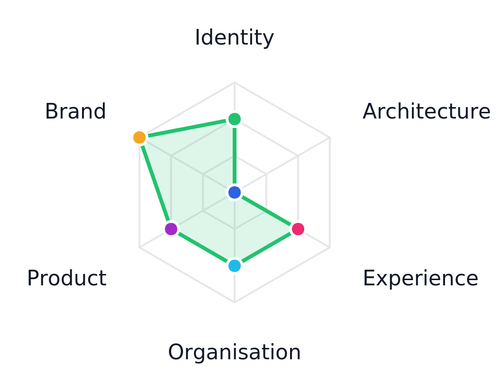
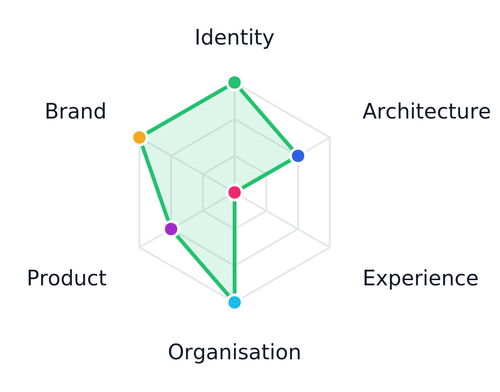
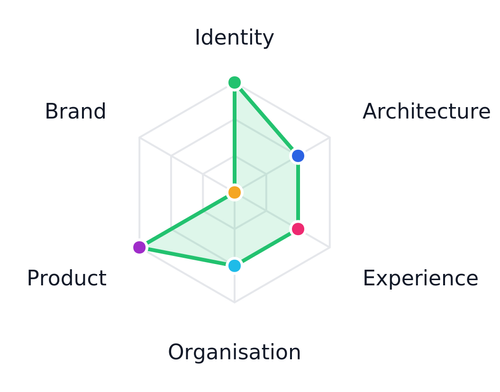
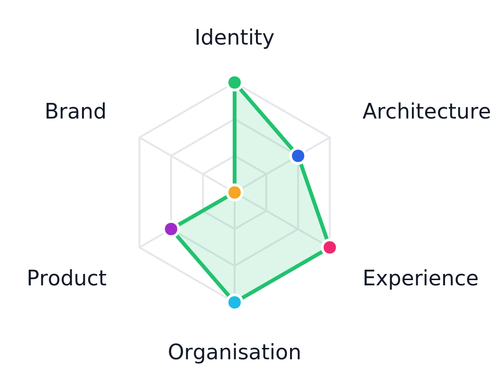
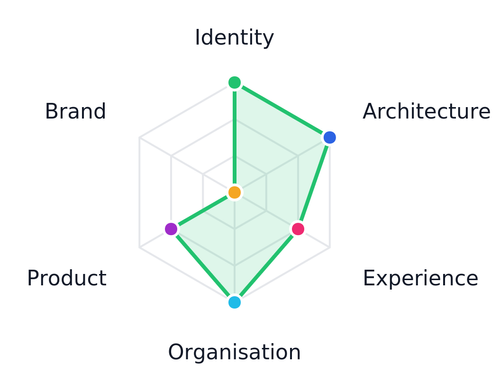
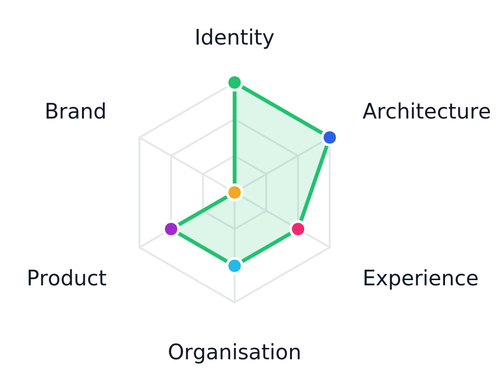
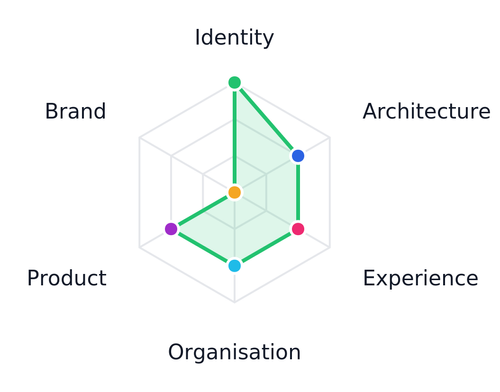
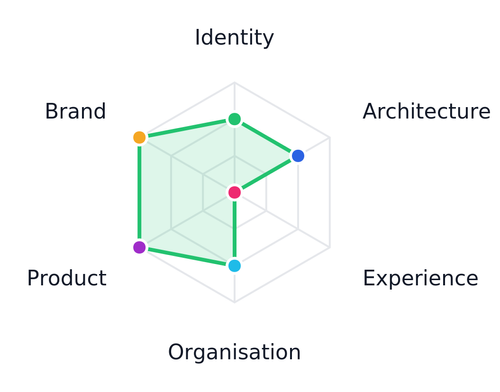
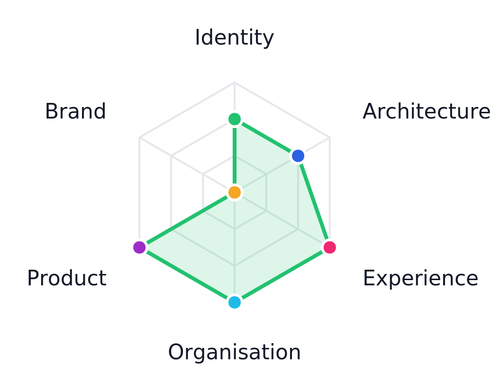
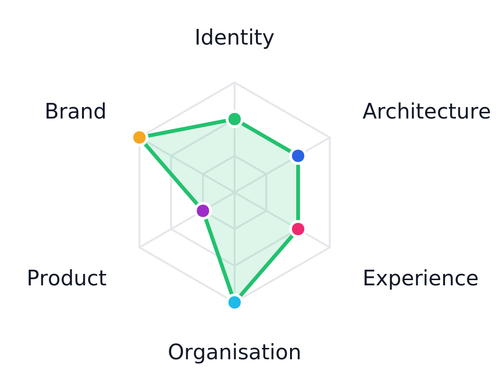
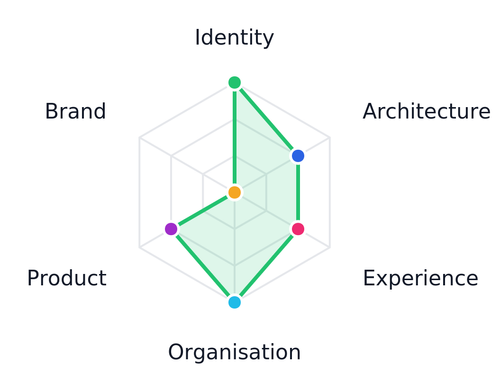
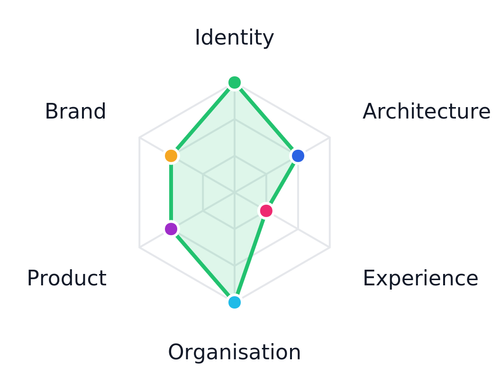
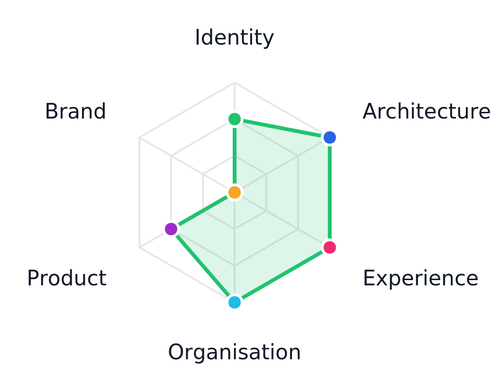
The home bases span brand consultancy, UN disaster prevention, automotive manufacturing, Spanish banking, research universities, the travel industry, state government, and product design. These speakers do not share a discipline. They share a willingness to take their own domain seriously and to take the rest of the enterprise seriously at the same time.
Use. The bridge-builder category supplies empirical evidence — not theoretical argument — that Enterprise Design extends across disciplinary boundaries in actual practice. The claim that "everyone plays a part" moves from aspirational framing to observable pattern.
Relations. Bridge-builder talks occupy the same archive as the other 132 essays. Specialist talks establish deep expertise in one area. Broader-disciplinary talks connect two or three areas. Bridge-builder talks connect five. All three categories serve the same collective practice, and each depends on the others.
A review of the 14 essays surfaces two shared characteristics beyond the EDGY scores.
Each talk treats adjacent dimensions as essential, not peripheral. The distinction between a specialist talk and a bridge-builder talk is not that the bridge-builder claims adjacent expertise. The distinction is that the bridge-builder treats adjacent dimensions as part of the problem. Abbing's Brand work requires organisational structures that support it. Lassi's research data work requires an academic Identity that frames it. A specialist talk focuses on its area. A bridge-builder talk considers what surrounds that area.
Each talk declines to claim the whole map. No essay in the 14 scores ≥ 2 on all six dimensions. Abbing's talk spans five dimensions and scores zero on Architecture — the speaker does not claim enterprise architecture expertise. Bridge-builders know where their expertise ends.
This pattern corresponds to the distinction Intersection Group materials draw between specialism and silo. A silo is not a specialism. A silo is a specialism that stops engaging with what surrounds it. Bridge-builder talks demonstrate the alternative: specialism that extends outward.
The pattern is not confined to the 14. Many of the 52 talks that score ≥ 2 on three dimensions, and many of the 34 that score ≥ 2 on four, exhibit variants of the same three characteristics. The bridge-builders are the most visible instances of a practice that appears across the archive.
The niche-discipline perception arises from a specific confusion: prospective practitioners search for "Enterprise Designers" as they would search for "UX Designers" or "Enterprise Architects" — a labelled job title with a labelled training pipeline. That labelled role does not widely exist yet. The conclusion becomes: Enterprise Design must be a small specialist field.
The 14 bridge-builder talks indicate the category error is in the question. Enterprise Design is not a job title. Enterprise Design is the practice that emerges when practitioners from different fields bring their discipline to a room where the whole enterprise is the shared subject. Each EDGY dimension has its own established professions: strategists and mission-and-vision consultants work on Identity; enterprise architects, business architects, and operations leads work on Architecture; service designers, UX designers, and CX practitioners work on Experience; organisation designers, transformation leads, and change managers work on Organisation; product managers, product designers, and service owners work on Product; brand managers, marketing leaders, and communications designers work on Brand. The Intersection Conference is where these practitioners convene.
The other 132 essays support the same reframing from a different angle. Specialist talks and broader-disciplinary talks make bridge-building possible: bridges require anchors on each side. Without specialists doing specialist work, the bridge-builders would have nothing to connect. The archive does not contain a separate class of "Enterprise Designers" distinct from the specialists. The archive contains practitioners from many disciplines doing work that, collectively, constitutes Enterprise Design.
The niche-discipline framing asks whether a single specialist field exists. The archive answers a different question: whether cross-disciplinary practice that makes enterprises coherent is visible and recurring. It is. The evidence is in the approximately 150 talks on YouTube.
Intersection 26 runs October 7–9 in Montréal. The theme this year is Beyond the Spark — moving past innovation theatre to the mechanics of impact, the work of bridging invention and execution.
That work belongs to bridge-builders. The 14 essays above show the practice already exists across industries, across disciplines, across continents. The conference is where the people doing that work meet, compare notes, and shape what comes next.
Blind Bird tickets are now available. They give full access to all three conference days at the lowest price the conference will offer, while the programme is still being shaped. They are a bet on the value of the conversation before the full agenda is revealed.
The corpus comprises 157 documents (11 conference-year overviews plus 146 essays covering individual talks) derived from the Intersection Conference YouTube archive for 2014–2025 (excluding 2021). Documents were structured into a uniform format using Google's NotebookLM: YAML metadata header, H2-divided body, and a closing "Keywords and Tags" list. Scoring applies to the curated metadata of each of the 146 essays (keyword tags weighted ×3, section headings ×2, title and abstract ×1) rather than body prose, which concentrates the signal on what each talk explicitly addresses.
Did you like this blog post? Never miss an update when we
publish next:
ENTERPRISE DESIGN PATTERNS
Capturing a wealth of experience from many sources, four world-class enterprise designers and architects present a collection of 35 immediately applicable solutions to successful enterprise design.
Buy the book