Innovation begins with a spark. An insight, a lingering annoyance, a new technology, a bold question. Intersection 26, the 12th global conference, running October 7–9 in Montréal, names this directly in its theme: Beyond the Spark: Turning ideas into impactful enterprises.
Most initiatives, however, do not survive scaling. The challenge is no longer generating ideas but designing the systems that let those ideas endure, grow, and deliver real-world impact. And the skills required to design for durability — not just creativity — live scattered across disciplines. Architecture, organisation design, strategy, product, brand. Most practitioners work inside one of these and reinvent the rest case by case.
What do enterprises that actually scale impact do differently, and how does a practitioner learn to see and design for those patterns?
Eleven years of Intersection Conference talks identify a recognisable pattern in enterprises that survive their own success. They are designed around durable Capabilities, coherent Organisations, and a Purpose that outlasts the founder's energy. These are not separate disciplines. They are three sides of the same enterprise. And they are what the EDGY 23 Language Foundations course teaches as a single language. The skills live together because the enterprise is one thing.
Three observations support this conclusion:
Enterprises that scale impact invest in Capabilities. A feature ships, a capability endures. It outlasts the product, the reorg, and the person who championed it. Four talks from the Intersection archive make this distinction concrete:
A common thread runs through these four talks: the speakers distinguish what the enterprise does today from what the enterprise is capable of doing, and they design for the latter. This is the skill Week 3 of the EDGY 23 course teaches: capability mapping, applied to operations and execution.
Enterprises that scale impact are not those with the tidiest org chart. They are those whose organisational structure, culture, and operating rhythms cohere — where the way people work together expresses the strategy rather than contradicting it. Four more talks name this distinction precisely.
All four talks treat Organisation as a designed dimension of the enterprise, not as HR's administrative layer. This is the Identity-Architecture intersection in EDGY terms, and it is what Week 2 of the course teaches: Organisation, leadership, and culture as objects of deliberate design.
Enterprises that outlast their founders, their funding rounds, and their market cycles share one structural property: a Purpose clear enough that decisions can be made against it when the founder is not in the room. Five talks locate this clearly.
Across these five talks, Purpose is a structural dimension of the enterprise (the Identity facet in EDGY terms) and it is what Week 1 of the course introduces. Not because Purpose comes first in time, but because the language for discussing Purpose comes first in the learning path.
The pattern across the archive is not that enterprises scale on Capabilities, or on Organisation, or on Purpose. It is that enterprises that scale impact do all three. Capabilities without coherent Organisation become silos. Organisation without Purpose becomes bureaucracy. Purpose without Capabilities becomes rhetoric.
This is why the EDGY 23 Language Foundations course teaches the three together as a single language, not as three separate disciplines. Practitioners come to the course from one home base (architecture, service design, strategy, product, organisation design, brand) and leave with the language to see and design across all three facets of the enterprise at once.
Two course facts matter for any practitioner considering the investment:
The course is taught by experienced practitioners, not theorists. The instructors apply EDGY in the field; the course draws on real challenges, not only case studies. Three of the speakers cited in this article (Anne Landréat, Dennis Middeke, and Oliver Cronk) are active in the Intersection Group ecosystem as authors, coaches, or contributors. The language the course teaches is the language being developed in these talks.
The course is cohort-based and collaborative. Practitioners work with peers from adjacent disciplines. This is not incidental: Enterprise Design is itself a cross-disciplinary practice, and the course structure mirrors that practice. Learning alone would defeat the point.
Intersection Group offers different entry points into the EDGY learning journey:
The EDGY 23 Language Foundations course is our flagship. A four-week remote cohort, leading to Certified EDGY Practitioner (Level 1). It is where practitioners learn the full EDGY language as a coherent whole.
The Getting Started with Enterprise Design workshop and the Enterprise Scan seminar are shorter entry points into EDGY. They help cross-disciplinary teams that need a shared language before a new initiative.
If you are ready to go deeper now, the upcoming Capability Modelling course is currently our most focused entry point into applied EDGY practice. Join us for the September cohort.
To stay informed about upcoming cohorts, new learning formats, and future EDGY training opportunities, join our newsletter!
Did you like this blog post? Never miss an update when we
publish next:
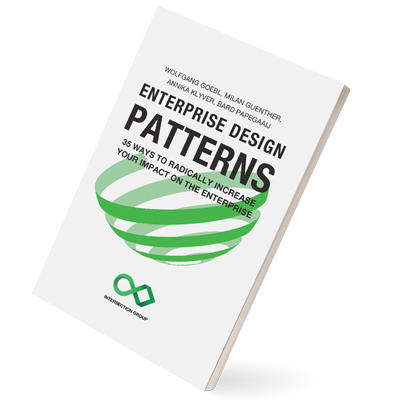
ENTERPRISE DESIGN PATTERNS
Capturing a wealth of experience from many sources, four world-class enterprise designers and architects present a collection of 35 immediately applicable solutions to successful enterprise design.
Buy the book