Jump to content
Toggle menu
Join the community

This article is an invitation. It was written by a conference organiser to brand practitioners who may not yet have heard of the conference. Its argument is that a decade-long conversation about enterprise coherence exists at the Intersection Conference, that brand strategists belong in it, and that the conversation has been quieter than it should be.


Brand, as a discipline, has always straddled strategy, design, and culture. At enterprise scale (multinational, multi-product, multi-decade) brand work stops being a campaign problem and becomes a coherence problem: how the brand expresses and is expressed by the identity, culture, operating model, and experience of the enterprise. Brand strategists working at this scale know the question. Their colleagues in adjacent disciplines are working on the same enterprise from different angles. The two groups rarely share a venue.

The Intersection Conference has, since 2014, hosted those adjacent disciplines in a common room. Enterprise architects, service designers, organisation designers, strategists, and product leaders have spent 11 years refining a shared language, EDGY, an open-source visual language for enterprise co-design, and a shared body of case studies. The conversation has value to brand. And yet the archive is quieter on Brand than it is on any other dimension.

Where can brand strategists engage the enterprise-coherence problem alongside the other disciplines that shape how enterprises show up in the world — and where is the conversation still open for them to join?

The Intersection Conference has been that venue for 11 years. And it has been waiting for more brand voices. The 12th edition, Intersection 26: Beyond the Spark, runs October 7–9 in Montréal. The quietness of Brand in the Intersection archive is not an accident of neglect. It is an invitation to join the conversation in Montréal.

Two observations frame what Brand strategists will find in the archive:

  • The strong Brand talks in the record treat brand as enterprise coherence, not as campaign work.
  • The gap between Brand and the rest of the enterprise, where the richest Brand-adjacent conversation could happen, is the conversation still waiting for its speakers.

Brand as coherence, not campaign: what the record contains

The handful of Brand talks in the Intersection archive share a family resemblance. They treat brand as the operational substrate of the enterprise: the thing that lets people inside the enterprise make consistent decisions without asking permission, and that lets people outside the enterprise know what to expect without being told. Five talks stand out:

  • Erik Roscam Abbing (Intersection 14, Paris): Designing Branded Enterprise Experiences.
    The opening talk of the first Intersection Conference, given by the founder of the brand-and-service-design consultancy Zilver, set the agenda for the decade that followed: brand is not what the enterprise says about itself, it is what the enterprise consistently does across every touchpoint, and designing that consistency is an enterprise-scale coherence problem. Abbing's framing — that experience design and brand design cannot be separated at enterprise scale — remains the clearest articulation in the archive of why brand strategists belong at an Enterprise Design conference in the first place.
  • Gerry McGovern (Intersection 15, Berlin): Designing for Trust. McGovern's thesis is that trust is the operational substrate of brand.
    Every interaction the enterprise has with a customer either earns trust or spends it, and the aggregate — brand — is the running balance. The talk is essential for brand practitioners who have argued with colleagues who treat brand as visual identity; McGovern's framing turns the argument into a question of design governance across the whole enterprise surface.
  • Chris Moody (Intersection 16, Copenhagen): Shaping a new, digital, and participatory era of energy.
    Moody, then at Wolff Olins, presented the brand work behind a European energy utility's transition from a centralised producer to a participatory platform. The talk is one of the few public treatments of what happens when a brand has to redesign itself to match a fundamentally changed operating model — not as communications, but as the coherent expression of a new kind of enterprise. Brand strategists working on transformation mandates will find the specific challenges they face named directly.
  • Bartek Balewski & Henryk Klawe (Intersection 20, Virtual): Even small local non-profit organisations can profit from using Enterprise Design.
    The title is unpromising; the content is strong. The talk is a case study of how a small Polish non-profit used Enterprise Design to align its identity, operations, and brand expression coherently — with a budget and timeline smaller than any mid-size enterprise brand project. For brand strategists serving SMEs or non-profit clients, the talk shows what enterprise-scale brand thinking looks like when the enterprise itself is small.
  • Pierre-Édouard Martial (Intersection 25, Brussels): Designing information like a living material.
    Martial's 2025 talk is the most recent Brand-adjacent contribution in the archive. It treats information design — how an enterprise represents itself through structured content — as a branded material that shapes perception, like a fabric or a typography. For brand practitioners working on digital-first brands, the talk bridges content strategy, information architecture, and brand expression in a way rarely attempted.

What the five talks have in common is that none of them treats brand as a marketing output. Each treats brand as the coherent expression of an enterprise's decisions, structures, and values, which is exactly the framing the rest of the Intersection community brings to their own disciplines.

What is not foundational, however, is the second conversation these talks invite and the archive has not yet had.


Where Brand meets the rest of the enterprise: the missing conversations

The strong Brand talks in the archive concentrate on a few of Brand's formal EDGY relationships: Brand and Identity (McGovern on trust), Brand and the journey (Martial on information as material). The under-represented relationships, visible as a gap in the record, are the three that most shape brand work at enterprise scale:

  • organisation builds brand: the question of who inside the enterprise is authorised to make brand decisions, and how brand governance works at portfolio scale.
  • product embodies brand: the question of how brand survives being expressed across dozens of products, business units, and partner channels without diluting or contradicting itself.
  • brand represents purpose: the question of how brand-as-signal stays aligned with enterprise-as-system when the operational reality diverges from the brand promise.

Brand strategists at enterprise scale will recognise the questions that live in those gaps:

  • How does brand governance work when the enterprise has hundreds of products across dozens of business units, each making brand-affecting decisions independently?
  • What is the relationship between a brand portfolio's structure (master brand, endorsed brands, sub-brands) and the organisational structure that owns each of them?
  • When a merger combines two enterprises, how does the combined brand survive the combined operating model. And how does the operating model survive the combined brand?
  • What does a brand-led transformation actually look like, and who inside the enterprise owns it?

These questions have answers. Brand strategists working inside enterprises are developing those answers every quarter. The conversations are happening in private consulting engagements, in internal decks, in the brand-organisation tension inside every large enterprise. They are not yet happening on the Intersection stage.

One talk in the current archive gestures at the gap without closing it:

  • Scott Ambler (Intersection 22, Stockholm): Enterprise Design: a disciplined look.
    Ambler, creator of the Disciplined Agile toolkit, compared EDGY to Disciplined Agile across all six EDGY dimensions, including Brand. His treatment of Brand is the treatment of a methodologist noting that the language has a Brand-shaped slot in it. What the archive has not yet had is the inverse talk: a brand strategist noting that brand work at enterprise scale depends on Organisation, Product, and Purpose in specific, articulable ways, and treating that dependence with the same seriousness that EDGY treats it.

Your next step

Brand strategists working at enterprise scale tend to be senior, scarce, and chronically under-attended-to by their own professional conferences. Brand New, Cannes Lions, and SXSW host excellent brand conversations, but they host few conversations where a brand strategist, an enterprise architect, and an organisation designer share a room and discuss the same enterprise. The Intersection Conference is that room.

Intersection 26 runs October 7–9, 2026, in Montréal. If the questions raised in this article resonate with your work, we'd love to welcome you to the conversation.

Join practitioners from a wide range of disciplines as we explore this year's theme, Beyond the Spark: Turning ideas into impactful enterprises, through talks, workshops, and discussions grounded in real-world practice.

Early Bird tickets are available for a limited time, giving you full access to all three conference days at a discounted rate.

We look forward to welcoming you to Montréal.


Did you like this blog post? Never miss an update when we publish next:
Subscribe to our blog

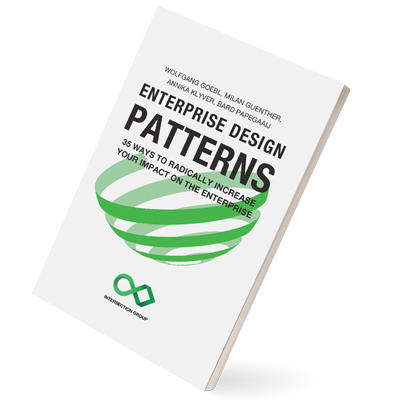
ENTERPRISE DESIGN PATTERNS

You work very hard, but does it really make a difference?

Capturing a wealth of experience from many sources, four world-class enterprise designers and architects present a collection of 35 immediately applicable solutions to successful enterprise design.

Buy the book

Intersection 26: Beyond the Spark

12th global conference on Enterprise Design
  • Conference
  • October 7–9, 2026, 09:00-17:30
  • Montréal (Québec), Canada

About the author

Paulo Tonin

Paulo Tonin

Community Lead
Intersection Group
Florianópolis, Brazil

Paulo works on the boundaries inside enterprises, where technical reality, organizational interests, and the story leadership believes about both tend to drift apart. Across almost two decades of work in business process management, enterprise design, and consulting, one discipline has stayed constant: hold the whole enterprise in view, keep its parts aligned, and surface the gaps before they become surprises. He writes and publishes frameworks on how complex organizations govern decisions and stay coherent as they grow, working through structured argument and a refusal to let any single view of a problem stand in for the whole.